- Home
- About Us
- Products
- News
- Blog
- Contact Us
Leave Your Message
Jaw Crusher Parts do more than keep a machine running. They affect throughput, product size, operating costs, and the time a plant spends offline. A worn jaw plate can leave uneven grooves. A mismatched toggle plate may create avoidable stress. Small differences matter.
Choosing replacements takes more than matching a part number. Buyers need to consider the crusher model, feed material, abrasiveness, production targets, and expected service life. Material grade and manufacturing quality also deserve attention. A part that looks right may still perform poorly under a different duty cycle. Check dimensions, installation requirements, and supplier documentation before ordering. Keep records of wear patterns, too. They can reveal whether the issue is the part, the feed, or operating conditions.
One source detail still needs verification: “[Insert a verified quotation from a named jaw crusher parts expert].” A real expert’s name and exact words should be confirmed against a reliable source, rather than invented. This guide’s ten tips will help readers compare parts, assess supplier claims, and ask more precise questions. Some choices remain imperfect. Wear rates vary, and a lower purchase price may not mean lower cost over time. The aim is practical: select Jaw Crusher Parts that fit the machine and the work, then review their performance in service.
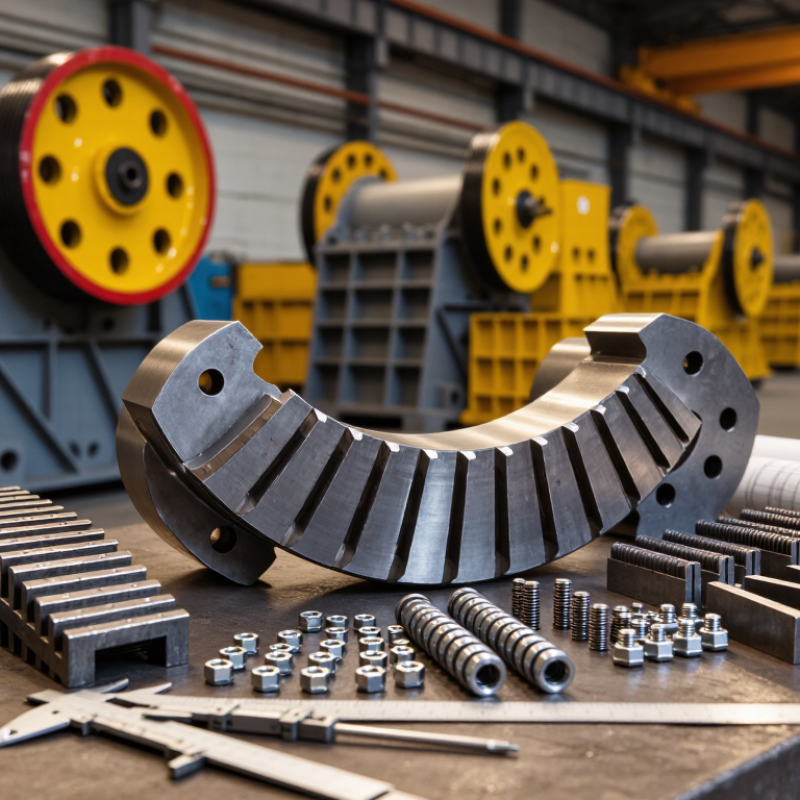
Identify Your Jaw Crusher Model and Part Specifications
Before ordering a jaw plate or toggle plate, record the crusher’s exact model and serial number. Check the equipment nameplate, usually fixed to the frame, and compare it with the parts manual. Small errors matter. Similar-looking crushers may use different mounting holes, plate thicknesses, or seating surfaces. Note whether you need a fixed or swing jaw, and confirm the machine’s feed opening and operating arrangement.
Use the parts drawing to verify dimensions, tooth profile, material, and fit. Measure the old part only as a cross-check; wear can change its shape and give you a misleading reading. Photograph the part beside a tape measure, and mark hole spacing and overall thickness in your notes. A common workshop mistake is identifying a part by appearance alone. It can fit loosely, wear unevenly, or delay a repair. If records are incomplete, pause and compare several measurements with the manual before confirming the specification. Even careful notes can miss a detail. That extra check is worth the time.
| Tip | Part or Detail | Information to Identify | Specifications to Record | Verification Check |
|---|---|---|---|---|
| 1 | Crusher model | Read the model designation from the machine identification plate or equipment documentation. | Model designation; jaw opening or feed-opening size, if listed; machine configuration. | Match the complete model designation to the parts drawing or parts list, not just the crusher type. |
| 2 | Serial number and build details | Record the serial number and any revision or build information shown in the equipment records. | Serial number; year or build date, if available; drawing or assembly revision. | Check for design changes across production runs; visually similar parts may not have the same fit. |
| 3 | Fixed and movable jaw dies | Identify which die is fixed and which moves, and note the mounting arrangement. | Overall length, width, thickness, hole or slot locations, and die profile; record measurements in millimetres. | Confirm orientation, seating surfaces, and fastener locations against the parts drawing. Do not assume the two dies are interchangeable. |
| 4 | Jaw-die tooth profile | Describe the tooth shape and spacing, and note any special profile specified for the application. | Tooth pitch and height; ridge or groove orientation; profile designation, if given. | Compare the profile with the existing die and approved drawing. Profile suitability depends on the feed material and operating conditions. |
| 5 | Wear-part material | Check the material specification for the jaw dies and other wear parts. | Specified alloy or grade; heat-treatment requirements; hardness range, when stated in the specification. | Manganese steel is commonly used for jaw dies. Confirm the required grade and application suitability from the machine documentation. |
| 6 | Cheek plates | Identify the side location and shape of each cheek plate inside the crushing chamber. | Plate length, width, thickness, profile, and mounting-hole pattern; left- or right-side position, if applicable. | Check the plate outline and fixing points against the drawing. Confirm the part clears adjacent components when installed. |
| 7 | Toggle plate and seats | Record the toggle plate shape and the matching seat geometry at both ends. | Plate length, width, thickness, end shape, and seat dimensions; include the specified part reference where available. | Verify that plate and seats are a compatible set for the crusher design. Do not substitute dimensions based on appearance alone. |
| 8 | Fasteners and retainers | Identify the hardware needed to secure the wear parts and retain them in position. | Thread size and pitch; length; head or nut type; quantity; specified strength class, where applicable. | Use the fastener specification and installation procedure for the machine. Check thread compatibility and required tightening method. |
| 9 | Other mechanical parts | For a pitman, shaft, bearing, or flywheel, use the part reference and assembly drawing rather than visual resemblance. | Part number or drawing reference; key dimensions; bearing type and size, if relevant; mounting and alignment details. | Confirm interfaces, clearances, and assembly orientation. These components may require precise fits and should be checked against approved documentation. |
| 10 | Measurements and final fit check | Compare the proposed part with the machine drawing and, where safe, the removed part. | Record units, measurement points, tolerances from the drawing, and any wear or damage observed. | Use a consistent unit system and suitable measuring tools. Never treat a worn component's dimensions as the original specification. |